应用项目大致的体系结构:
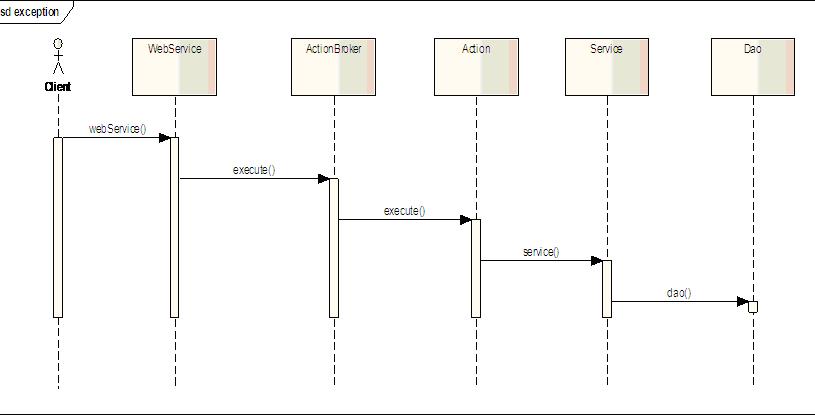
该异常处理框架满足的要求:
- 完整的异常组织结构
- 异常的统一处理
- 可配置,受管式,方便使用
完整的异常组织结构:
- 用户可以方便的定义自己的异常,但所有UncheckedException需要继承BaseAppRuntimeException,所有的checked Exception可以继承BaseAppException,或者需要抛出且不需要check时用WrapperredAppException封装后抛出
- 合理地使用checked异常
- Exception有唯一的error code,这样用户报告异常后,可以根据异常号找到相应Exception,把exception直接显示给用户也没有太大的意义,如何纪录exception那就是下文讲到的ExceptionHandler的职责了。
- 如果是第三方包括jdk中的异常,需要封装成BaseAppException或者BaseAppRuntimeException后抛出

统一的异常处理
异常统一在框架中进行处理,不需要在上层应用的代码中去处理抛出的异常。为了尽量捕捉到所有的异常,将异常处理放在了ActionBroker中,这样凡是action以后抛出的异常都可以捕捉到,因为webservice只是简单的调用action类的方法,一般不会出现异常。当我们捕捉到异常后,需要进行异常处理,定义了ExceptionHandler接口,用接口抽象出异常处理类的具体实现。

USFContextFactory: 创建ExceptionContext的工厂
1 package com.ldd600.exception.context;
2
3
 public class CoreContextFactory
  {
{
4 private static CoreContextFactory instance;
5
6 private volatile ExceptionContext exceptionContext;
7
8 private Object exceptionContextLock = new Object();
9
10
 private CoreContextFactory() {
11
12 }
}
13
14 public static synchronized CoreContextFactory getInstance() {
15 if (null == instance) {
16 instance = new CoreContextFactory();
17 }
18 return instance;
19 }
20
21 public ExceptionContext getExceptionContext() {
22 ExceptionContext tempExpContext = exceptionContext;
23 if (tempExpContext == null) {
24 synchronized (exceptionContextLock) {
25 tempExpContext = exceptionContext;
26 if (tempExpContext == null)
27 exceptionContext = tempExpContext = new ExceptionContext();
28 }
29 }
30 return tempExpContext;
31 }
32 }
}
33
ExceptionContext: 存放全局的exception信息
1package com.ldd600.exception.context;
2
3import java.util.ArrayList;
4import java.util.Collection;
5import java.util.Collections;
6import java.util.HashMap;
7import java.util.List;
8import java.util.Map;
9import java.util.Set;
10
11import org.springframework.util.Assert;
12
13import com.ldd600.exception.base.BaseAppRuntimeException;
14import com.ldd600.exception.base.ConfigException;
15import com.ldd600.exception.base.handler.ExceptionHandler;
16import com.ldd600.exception.config.ExceptionDefinition;
17
18public class ExceptionContext {
19 private Map<Class<?>, ExceptionDefinition> exceptionMap;
20
21 private Map<String, ExceptionHandler> handlers = new HashMap<String, ExceptionHandler>();
22
23 ExceptionContext() {
24 exceptionMap = new HashMap<Class<?>, ExceptionDefinition>();
25 }
26
27 public boolean containsException(Class<?> expClazz) {
28 return (exceptionMap.containsKey(expClazz));
29 }
30
31 public void addExceptionHander(Class<?> expClazz, Class<? extends ExceptionHandler> handlerClazz) {
32 try {
33 ExceptionDefinition definition = getRealExceptionDefinition(expClazz);
34 if (null == definition) {
35 throw new IllegalArgumentException(expClazz.getName() + "not in the context, please configure or add it to the context first!!");
36 }
37 ExceptionHandler handler = handlers.get(handlerClazz.getName());
38 if (null == handler) {
39 handler = handlerClazz.newInstance();
40 handlers.put(handlerClazz.getName(), handler);
41 }
42
43 definition.getHandlerNames().add(handlerClazz.getName());
44 } catch (Exception ex) {
45 throw new ConfigException("Add exception handler to context failure!", ex);
46 }
47 }
48
49 public void addExceptionHandler(Class<?> expClazz, String errorCode, Class<? extends ExceptionHandler> handlerClazz) {
50 Assert.hasLength(errorCode, expClazz + " errorCode must not be null or empty string!");
51 ExceptionDefinition definition = getRealExceptionDefinition(expClazz);
52 if(null == definition) {
53 definition = new ExceptionDefinition(errorCode);
54 exceptionMap.put(expClazz, definition);
55 }
56 addExceptionHander(expClazz, handlerClazz);
57 }
58
59
60
61 public void addExceptionHandlers(Class<?> expClazz, Class<? extends ExceptionHandler> handlerClazzes) {
62 for(Class<? extends ExceptionHandler> handlerClazz : handlerClazzes) {
63 addExceptionHander(expClazz, handlerClazz);
64 }
65 }
66
67 public void removeExceptionHandler(Class<?> expClazz, Class<? extends ExceptionHandler> handlerClazz) {
68 Assert.isTrue(containsException(expClazz));
69 String handlerName = handlerClazz.getName();
70 getExceptionDefinition(expClazz).getHandlerNames().remove(handlerName);
71 Collection<ExceptionDefinition> definitons = exceptionMap.values();
72 boolean isClearHandler = true;
73 for (ExceptionDefinition expDefinition : definitons) {
74 if (expDefinition.getHandlerNames().contains(handlerName)) {
75 isClearHandler = false;
76 break;
77 }
78 }
79
80 if (isClearHandler) {
81 handlers.remove(handlers.get(handlerName));
82 }
83 }
84
85 public void setExceptionDefinition(Class<?> expClazz, ExceptionDefinition definition) {
86 exceptionMap.put(expClazz, definition);
87 }
88
89 public ExceptionDefinition getExceptionDefinition(Class<?> expClazz) {
90 if (containsException(expClazz)) {
91 return exceptionMap.get(expClazz);
92 } else if (BaseAppRuntimeException.class.isAssignableFrom(expClazz.getSuperclass())) {
93 return getExceptionDefinition(expClazz.getSuperclass());
94 } else {
95 return null;
96 }
97 }
98
99 public ExceptionDefinition getRealExceptionDefinition(Class<?> expClazz) {
100 return exceptionMap.get(expClazz);
101 }
102
103 public List<ExceptionHandler> getExceptionHandlers(Class<?> expClazz){
104 ExceptionDefinition definition = getExceptionDefinition(expClazz);
105 if (null != definition) {
106 Set<String> handlerNames = definition.getHandlerNames();
107 List<ExceptionHandler> handlerList = new ArrayList<ExceptionHandler>(handlerNames.size());
108 for (String handlerName : handlerNames) {
109 ExceptionHandler handler = handlers.get(handlerName);
110 handlerList.add(handler);
111 }
112 List<ExceptionHandler> resultHandlerList = new ArrayList<ExceptionHandler>(handlerList);
113 return resultHandlerList;
114 } else {
115 return Collections.<ExceptionHandler> emptyList();
116 }
117 }
118
119 public String getErrorCode(Class<?> expClazz){
120 ExceptionDefinition definition = getExceptionDefinition(expClazz);
121 if (null != definition) {
122 return definition.getErrorCode();
123 } else {
124 return "";
125 }
126 }
127
128
129}
130
ExceptionDefinition: Exception信息单元
1package com.ldd600.exception.config;
2
3import java.util.LinkedHashSet;
4import java.util.Set;
5
6public class ExceptionDefinition {
7 private String errorCode;
8
9 private Set<String> handlerNames = new LinkedHashSet<String> ();
10
11 ExceptionDefinition() {
12
13 }
14
15 public ExceptionDefinition(String errorCode) {
16 this.errorCode = errorCode;
17 }
18
19 public String getErrorCode() {
20 return errorCode;
21 }
22
23 public void setErrorCode(String errorCode) {
24 this.errorCode = errorCode;
25 }
26
27 public Set<String> getHandlerNames() {
28 return handlerNames;
29 }
30}
31
ExceptionDefiniton定义了和某个exception相关的具体信息,根据exception的class name可以从exceptionContext中的exceptionMap得到指定的exception的相关信息,这些信息是在系统初始化时读取到exceptionContext中的。并且避免了exception handler的重复初始化。
可配置,受管式,方便使用
采取两种配置方式,exception的相关信息比如它的errorCode, exceptionHandlers可以配置在外部的xml文件中,也可以用annotation标注。对于exception的处理是有继承性质的,如果某个exception没有在exceptionContext中注册,就使用它的父类的配置信息。如果无任何父类在exceptionContext中注册,就使用默认机制进行处理。
XML 方案:
因为spring2.0支持自定义schema功能,我们可以方便地采用自己的schema只要实现NamespaceHandler和BeanDefinitionPaser,后面一个比较重要,可以将自定义xml文件中的相关类注册到spring的上下文中,成为spring bean。
Xml schema:
<xsd:complexType name="exceptionType">
<xsd:sequence>
<xsd:element name="level" default="error" minOccurs="0">
<xsd:simpleType>
<xsd:restriction base="xsd:string">
<xsd:enumeration value="error" />
<xsd:enumeration value="warning" />
<xsd:enumeration value="info" />
<xsd:enumeration value="confirmation" />
</xsd:restriction>
</xsd:simpleType>
</xsd:element>
<xsd:element name="handler" maxOccurs="unbounded">
<xsd:simpleType>
<xsd:restriction base="xsd:string" />
</xsd:simpleType>
</xsd:element>
</xsd:sequence>
<xsd:attribute name="errorCode">
<xsd:simpleType>
<xsd:restriction base="xsd:string">
<xsd:whiteSpace value="preserve" />
<xsd:pattern value="LDD600-+\d{1,5}.*" />
</xsd:restriction>
</xsd:simpleType>
</xsd:attribute>
<xsd:attribute name="class" type="xsd:string" use="required" />
</xsd:complexType>
Annotation方案:
JDK1.5以上就有了annotation,可以简化我们的配置,使得配置信息和代码联系在一起,增加了代码的可读性。如何在spring中注册自定义的annotation和用annotation标注的class,可以参考文章2和文章: 。对于每个注册了的class用ExceptionalAnnotationBeanPostProcessor来parse具体的annotation信息(对于annotation的parse方法还会在以后继续改进)。
1package com.ldd600.exception.annotation;
2
3import java.lang.annotation.Documented;
4import java.lang.annotation.ElementType;
5import java.lang.annotation.Retention;
6import java.lang.annotation.RetentionPolicy;
7import java.lang.annotation.Target;
8
9import com.ldd600.exception.base.handler.ExceptionHandler;
10
11@Target({ElementType.TYPE})
12@Retention(RetentionPolicy.RUNTIME)
13@Documented
14public @interface Exceptional {
15 String errorCode();
16 Class<? extends ExceptionHandler>[] handlers();
17}
18
1package com.ldd600.exception.processor;
2
3import org.springframework.beans.BeansException;
4import org.springframework.beans.factory.config.BeanPostProcessor;
5
6import com.ldd600.exception.annotation.Exceptional;
7import com.ldd600.exception.base.BaseAppException;
8import com.ldd600.exception.base.BaseAppRuntimeException;
9import com.ldd600.exception.config.ExceptionDefinition;
10import com.ldd600.exception.context.ExceptionContext;
11import com.ldd600.exception.context.CoreContextFactory;
12
13public class ExceptionalAnnotationBeanPostProcessor implements BeanPostProcessor {
14
15 public Object postProcessAfterInitialization(Object bean, String beanName) throws BeansException {
16 if(bean instanceof BaseAppRuntimeException || bean instanceof BaseAppException) {
17 Exceptional exceptional = bean.getClass().getAnnotation(Exceptional.class);
18 if(null != exceptional) {
19 ExceptionContext ctx = CoreContextFactory.getInstance().getExceptionContext();
20 if(!ctx.containsException(bean.getClass())) {
21 ExceptionDefinition expDefinition = new ExceptionDefinition(exceptional.errorCode());
22 ctx.setExceptionDefinition(bean.getClass(), expDefinition);
23 }
24 ctx.addExceptionHandlers(bean.getClass(), exceptional.handlers());
25 return null;
26 }
27 }
28 return bean;
29 }
30
31 public Object postProcessBeforeInitialization(Object bean, String beanName) throws BeansException {
32 return bean;
33 }
34
35}
36
结果测试:
1package com.ldd600.exception.test;
2
3import org.jmock.Expectations;
4import org.jmock.Mockery;
5import org.springframework.beans.factory.BeanFactory;
6
7import com.ldd600.exception.action.BusinessAction;
8import com.ldd600.exception.base.BaseAppException;
9import com.ldd600.exception.base.BaseAppRuntimeException;
10import com.ldd600.exception.base.ConfigException;
11import com.ldd600.exception.base.handler.ConsoleHandler;
12import com.ldd600.exception.context.CoreContextFactory;
13import com.ldd600.exception.dto.DefaultRequest;
14import com.ldd600.exception.dto.DefaultResponse;
15import com.ldd600.exception.dto.Request;
16import com.ldd600.exception.dto.Response;
17import com.ldd600.exception.webservice.ActionBrokerImpl;
18
19public class ExceptionTest extends DependencyInjectionExceptionTestCase {
20 Mockery context = new Mockery();
21 ActionBrokerImpl broker = new ActionBrokerImpl();
22 final Request request = new DefaultRequest();
23 final Response response = new DefaultResponse();
24
25 @Override
26 protected String[] getConfigLocations() {
27 return new String[] { "applicationContext.xml" };
28 }
29
30 public void testExceptionThrow() {
31 final BusinessAction<Response, Request> action = context
32 .mock(BusinessAction.class);
33 final BeanFactory beanFactory = context.mock(BeanFactory.class);
34 assertThrowing(new Closure() {
35 public void run() throws Throwable {
36 context.checking(new Expectations() {
37 {
38 allowing(beanFactory).getBean("action");
39 will(returnValue(action));
40 one(action).execute(request, response);
41 will(throwException(new BaseAppException()));
42 }
43 });
44 broker.setExceptionHandler(new ConsoleHandler());
45 broker.setBeanFactory(beanFactory);
46 broker.execute("action", request, response);
47 }
48
49 }, BaseAppException.class);
50 }
51
52 public void testExceptionalAutoLoad() throws BaseAppException {
53 final BeanFactory beanFactory = context.mock(BeanFactory.class);
54 final BusinessAction<Response, Request> action = context
55 .mock(BusinessAction.class);
56 context.checking(new Expectations() {
57 {
58 allowing(beanFactory).getBean("action");
59 will(returnValue(action));
60 one(action).execute(request, response);
61 will(throwException(new ConfigException()));
62 }
63 });
64 broker.setBeanFactory(beanFactory);
65 broker.execute("action", request, response);
66 assertEquals(CoreContextFactory.getInstance().getExceptionContext()
67 .getErrorCode(ConfigException.class), "LDD600-00002");
68 context.assertIsSatisfied();
69 }
70
71 public void testRuntimeException() {
72 final BusinessAction<Response, Request> action = context
73 .mock(BusinessAction.class);
74 final BeanFactory beanFactory = context.mock(BeanFactory.class);
75 assertThrowing(new Closure() {
76 public void run() throws Throwable {
77 context.checking(new Expectations() {
78 {
79 allowing(beanFactory).getBean("action");
80 will(returnValue(action));
81 one(action).execute(request, response);
82 will(throwException(new BaseAppRuntimeException()));
83 }
84 });
85 broker.setExceptionHandler(new ConsoleHandler());
86 broker.setBeanFactory(beanFactory);
87 broker.execute("action", request, response);
88 }
89
90 }, BaseAppRuntimeException.class);
91 // test config
92 assertEquals(CoreContextFactory.getInstance().getExceptionContext()
93 .getErrorCode(BaseAppRuntimeException.class), "LDD600-00001");
94 // test handler
95 assertFalse(response.isSuccess());
96 assertEquals(response.getErrorCode(), CoreContextFactory.getInstance()
97 .getExceptionContext().getErrorCode(
98 BaseAppRuntimeException.class));
99 context.assertIsSatisfied();
100 }
101
102 public void testCheckedException() {
103 final BusinessAction<Response, Request> action = context
104 .mock(BusinessAction.class);
105 final BeanFactory beanFactory = context.mock(BeanFactory.class);
106 assertThrowing(new Closure() {
107 public void run() throws Throwable {
108 context.checking(new Expectations() {
109 {
110 allowing(beanFactory).getBean("action");
111 will(returnValue(action));
112 one(action).execute(request, response);
113 will(throwException(new ExceptionFaker()));
114 }
115 });
116 broker.setBeanFactory(beanFactory);
117 broker.execute("action", request, response);
118 }
119
120 }, ExceptionFaker.class);
121 // test config
122 assertEquals(CoreContextFactory.getInstance().getExceptionContext()
123 .getErrorCode(ExceptionFaker.class), "LDD600-00003");
124 // test handler
125 assertFalse(response.isSuccess());
126 assertEquals(response.getErrorCode(), CoreContextFactory.getInstance()
127 .getExceptionContext().getErrorCode(
128 ExceptionFaker.class));
129 context.assertIsSatisfied();
130 }
131}
132
参考资料:
文章1:http://www.onjava.com/pub/a/onjava/2006/01/11/exception-handling-framework-for-j2ee.html
文章2:http://sannotations.sourceforge.net/
本文源代码:源代码下载